
In December 2025, the Parliament passed the Viksit Bharat – Guarantee for Rozgar and Ajeevika Mission (Gramin), popularly known as VB-G RAM G. This Act officially replaces the two-decade-old MGNREGA (2005), marking a strategic shift from “Relief-Based Work” to “Productive Livelihood Creation.
Under the mentorship of Dr. Ramanna Gowda, we have broken down the core differences that every aspirant must know for the upcoming KPSC and UPSC mains.
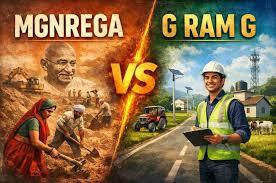
| Feature | MGNREGA (2005) | VB-G RAM G (2025-26) |
| Full Form | Mahatma Gandhi National Rural Employment Guarantee Act | Viksit Bharat – Guarantee for Rozgar and Ajeevika Mission (Gramin) |
| Guaranteed Days | 100 Days per household | 125 Days per household |
| Primary Focus | Manual unskilled labor (Wage focus) | Rozgar + Ajeevika (Livelihood & Skill focus) |
| Funding Model | 100% Central funding for unskilled wages | 60:40 sharing between Centre and States (90:10 for NE/Himalayan states) |
| Planning Approach | Demand-driven (Bottom-up) | Supply-driven (Based on Viksit Gram Panchayat Plans) |
| Agricultural Pause | No formal pause | 60-day mandatory pause during peak sowing/harvesting seasons |
| Asset Creation | Community assets (Ponds, roads) | High-value assets linked to PM Gati Shakti & Climate Resilience |
While MGNREGA was a legal “Right to Work” on demand, VB-G RAM G operates as a Centrally Sponsored Scheme (CSS). It integrates rural employment with other flagship missions like DAY-NRLM (Self-Help Groups) and PM Gati Shakti to ensure that the work done creates “Durable Infrastructure.”
Recognizing the rising cost of living and climate-induced agricultural distress, the government has increased the work ceiling to 125 days. This provides an additional 25% income potential for rural households.
One of the biggest criticisms of MGNREGA was that it competed with farmers for labor during peak seasons. VB-G RAM G introduces a 60-day “Agricultural Pause,” ensuring workers are available for farming while still guaranteeing their 125 days of work during the off-season.
The new Act introduces the Viksit Bharat National Rural Infrastructure Stack. This uses AI and real-time geo-tagging to ensure that money spent actually results in a productive asset, reducing the “digging and filling holes” perception of the past.
According to Dr. Ramanna Gowda, students should focus on the Fiscal Federalism aspect of this change. Since states now have to bear 40% of the cost, this will significantly impact the budgets of states like Karnataka.
“The shift from 100% Central funding to a 60:40 split is a major talking point for GS-2. It tests the financial autonomy of states and their ability to implement social safety nets.” — Dr. Ramanna Gowda
Stay updated with the latest in Indian Governance and Economy. Our classroom programs and test series are meticulously updated to include these recent legislative changes.
Visit us: www.amoghavarshaiaskas.in
Expert Mentorship: Dr. Ramanna Gowda
Call for Admissions: +91 9916766911
Location: Bangalore, Karnataka.
“The transition from MGNREGA to the VB-G RAM G Act, 2025, marks a strategic shift from a ‘Demand-Driven’ entitlement to a ‘Productive Asset-Led’ employment framework. Critically analyze the implications of the 60:40 funding split on the fiscal autonomy of states and the potential challenges in ensuring a rural safety net.”
1. Introduction:
Define the VB-G RAM G Act, 2025 (Viksit Bharat – Guarantee for Rozgar and Ajeevika Mission Gramin).
Mention that it replaces MGNREGA (2005) with an enhanced guarantee of 125 days (up from 100) but introduces a Centrally Sponsored Scheme (CSS) model.
2. Key Shifts (The ‘Strategic Shift’):
Entitlement vs. Budget: Moving from an open-ended “demand-driven” model to a “normative allocation” (budget-capped) system determined by the Centre.
Asset Focus: Integration with the Viksit Bharat National Rural Infrastructure Stack to ensure high-value, durable assets (Water, Roads, Livelihood) instead of temporary works.
Agricultural Balance: The 60-day “Agricultural Pause” to align with sowing/harvesting seasons.
3. Implications of the 60:40 Funding Split:
Fiscal Burden on States: Unlike MGNREGA (where the Centre paid 100% of unskilled wages), states now bear 40% of the total cost. This may strain the budgets of states with higher rural poverty but lower revenue.
Accountability: With skin in the game, states are incentivized to reduce leakages and ensure asset quality.
Regional Disparity: States like Karnataka (with a strong IT/service tax base) might manage, but fiscally stressed states might struggle to meet the demand for work.
4. Challenges to the Rural Safety Net:
Budget Caps: If a state’s “normative allocation” is exhausted during a drought or crisis, can it still provide a “guarantee” of work?
Digital Barrier: Mandatory biometric and AI-based monitoring could exclude workers in areas with poor connectivity.
The Pause: While helpful for farmers, the 60-day pause may hurt landless laborers who have no alternative income during those months.
5. Conclusion:
Conclude by stating that while VB-G RAM G modernizes rural development and improves asset quality, its success depends on maintaining the “Guarantee” aspect of the law and ensuring that fiscal federalism doesn’t lead to a dilution of the rural social safety net.
Dr. Ramanna Gowda often emphasizes that “Terminology is Key.” When writing about this in the KPSC KAS exam, ensure you use terms like “Normative Allocation,” “Viksit Gram Panchayat Plans,” and “Livelihood-Related Infrastructure.” Would you like me to create a 1-page “Comparison PDF Summary” text that you can offer as a free download link on your website?
VB-G RAM G vs. MGNREGA: A Comparative Analysis
This video provides an overview of the policy changes and the rationale behind the government’s transition to the new rural employment framework.
Maximize the benefits of mock tests for IAS and KAS preparation with guidance from Amoghavarsha IAS Academy . For more details, visit https://amoghavarshaiaskas.in/.
Youtube: click here


Amoghavarsha IAS/KAS Academy was founded in 2014 since from their we have been excellence in the field of civil Service examination preparation and state services. The Academy is completely dedicated to provide excellent quality education by experts and bringing innovations etc.
Copyright © 2014 – 2024 Amoghavarsha IAS Academy. All Rights Reserved
Developed & Maintained by BIGGSITE– Manikanta G.V
Amoghavarsha E Magazine
Current Affairs ( Prelims )
UPSC
KPSC