
India’s space exploration journey, spearheaded by the Indian Space Research Organisation (ISRO), has reached another milestone with the launch of Aditya-L1, India’s first dedicated solar mission. Aditya-L1 is designed to study the Sun, particularly its outermost layer, the corona. The mission’s primary objective is to explore the impact of solar activities on space weather and to unravel some of the long-standing mysteries of our closest star, the Sun.
The mission is named after Aditya, the Sanskrit word for the Sun. The “L1” in its name refers to the Lagrange Point 1, a stable point in space where the gravitational pull of the Earth and the Sun cancels out, allowing a satellite placed there to remain in a fixed position relative to the Earth and the Sun. This unique vantage point enables continuous observation of the Sun without being eclipsed by the Earth, which is crucial for uninterrupted data collection.
Aditya-L1 is a significant step forward in India’s scientific exploration of space. It marks a critical advancement in solar studies and opens up new opportunities for collaboration with other space agencies.
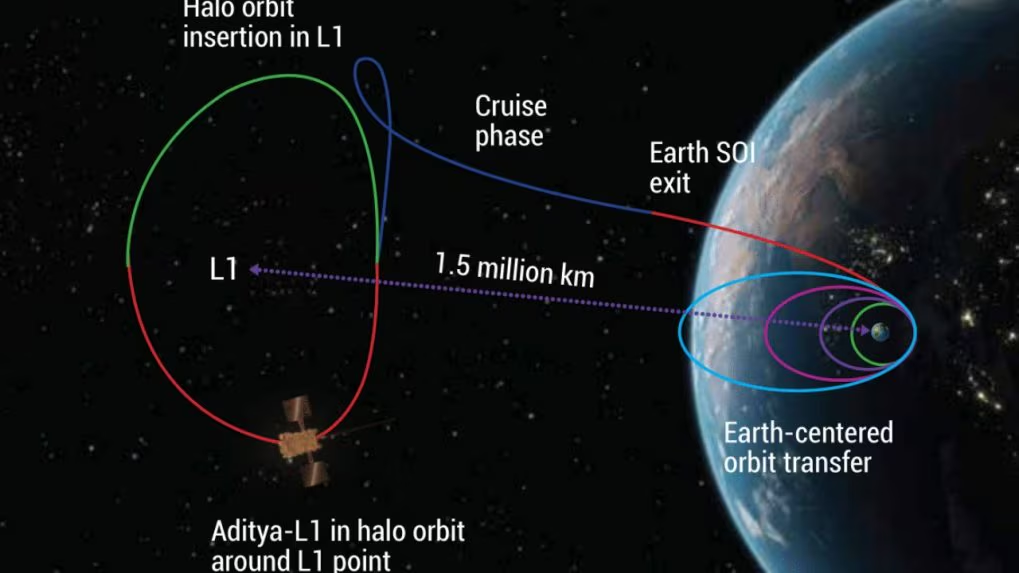
Aditya-L1 is a solar observatory mission, and its primary focus is to study the Sun’s corona, the outermost layer of the Sun, which can reach temperatures of millions of degrees Celsius. Understanding the corona is crucial for several reasons:
Solar Winds and Space Weather: The Sun’s corona is the source of solar winds, streams of charged particles that can have significant effects on space weather. These solar winds can interact with Earth’s magnetic field, causing phenomena such as auroras but also disrupting satellite communications, GPS systems, and even power grids. A better understanding of the corona can help scientists predict space weather and mitigate its impact on technology.
Coronal Mass Ejections (CMEs): CMEs are massive bursts of solar wind and magnetic fields rising above the solar corona and are often associated with solar flares. These ejections can cause geomagnetic storms when they collide with Earth’s magnetosphere, leading to disruptions in electrical grids and communication systems. Aditya-L1 aims to study the properties of CMEs to better predict these events.
Solar Magnetic Fields: The mission will study the dynamics of the Sun’s magnetic field and how it influences the corona and solar activities. Understanding the solar magnetic field can provide insights into the origins of space weather and its effects on Earth.
Solar Flares: Solar flares are sudden, intense bursts of radiation from the Sun. By observing these flares and their interaction with the corona, Aditya-L1 will help improve our understanding of solar energy release mechanisms.
Aditya-L1 is equipped with seven payloads designed to study different aspects of the Sun. These instruments will provide a comprehensive understanding of solar phenomena, ranging from electromagnetic radiation to energetic particles and magnetic fields.
Visible Emission Line Coronagraph (VELC): This is the primary instrument onboard Aditya-L1. It is designed to image the solar corona and study its temperature, velocity, and density. VELC will help scientists understand the processes that heat the corona and accelerate the solar wind.
Solar Ultraviolet Imaging Telescope (SUIT): SUIT will capture full-disk images of the Sun in the ultraviolet (UV) spectrum. These images will provide detailed insights into the outer layers of the Sun, including the chromosphere and the transition region.
Solar Low Energy X-ray Spectrometer (SoLEXS): SoLEXS will measure solar flares and their X-ray emissions, contributing to the study of energy release and particle acceleration in solar flares.
High Energy L1 Orbiting X-ray Spectrometer (HEL1OS): This instrument will observe solar flares in the hard X-ray range, providing data on high-energy solar events.
Aditya Solar Wind Particle Experiment (ASPEX): ASPEX will study the composition and velocity of solar wind particles. Understanding solar wind properties is critical for predicting space weather.
Plasma Analyser Package for Aditya (PAPA): PAPA will investigate the energetic ions present in the solar wind and their interaction with the Earth’s magnetosphere.
Magnetometer: The magnetometer onboard Aditya-L1 will measure the strength and nature of the interplanetary magnetic field (IMF) at the Lagrange point.
The placement of Aditya-L1 at the Lagrange Point 1 is a strategic decision. The L1 point is located about 1.5 million kilometers from Earth, between the Earth and the Sun. It provides a continuous and unobstructed view of the Sun, allowing Aditya-L1 to monitor solar activities in real-time without interruptions caused by Earth’s shadow. This makes L1 an ideal location for studying the Sun.
There are five such points in the Earth-Sun system, known as Lagrange points, where the gravitational forces of two large celestial bodies (like the Earth and Sun) balance the centrifugal force felt by a smaller object (like a satellite). Aditya-L1 will remain in a stable orbit at L1, which will enable it to gather consistent data on solar activities.
Indigenous Space Technology: The Aditya-L1 mission highlights India’s advancements in space technology and its capability to design complex scientific missions. This is a crucial point for questions related to India’s space capabilities and its role in global space exploration.
Space Weather and Its Impact: Space weather phenomena like solar winds, CMEs, and solar flares can have a direct impact on Earth’s technology, from power grids to satellites. Understanding space weather is crucial for national security, telecommunications, and disaster management—topics of importance in Disaster Management and Security sections of the UPSC syllabus.
International Collaborations: Aditya-L1 also opens up possibilities for international collaborations with other space agencies like NASA and ESA, which are also focused on solar research. This is relevant for questions on India’s international scientific partnerships and collaborations in space technology.
Scientific Achievements: Questions on scientific achievements by India can prominently feature Aditya-L1. This mission represents a unique opportunity for India to make significant contributions to solar physics and space weather forecasting.
Climate Change and Earth Sciences: Space weather can influence Earth’s atmosphere and climate to some extent. Understanding solar dynamics is part of the broader study of climate change and atmospheric sciences, making Aditya-L1 relevant to the Environment and Climate Change section of the UPSC syllabus.
Aditya-L1 represents India’s commitment to advancing its scientific understanding of space, particularly the Sun. The mission’s success will not only enhance India’s space research capabilities but also contribute to global efforts in studying solar phenomena and mitigating the effects of space weather on Earth. For UPSC aspirants, understanding the technical and scientific aspects of Aditya-L1, its relevance to space weather, and its potential applications in telecommunications, disaster management, and national security is essential for answering questions on Science and Technology, Environment, and Disaster Management in the UPSC exams.
The Aditya-L1 mission is a proud moment for India, reflecting its growing prowess in space exploration and its readiness to explore new frontiers in science and technology.


Amoghavarsha IAS/KAS Academy was founded in 2014 since from their we have been excellence in the field of civil Service examination preparation and state services. The Academy is completely dedicated to provide excellent quality education by experts and bringing innovations etc.
Copyright © 2014 – 2024 Amoghavarsha IAS Academy. All Rights Reserved
Developed & Maintained by BIGGSITE– Manikanta G.V
Amoghavarsha E Magazine
Current Affairs ( Prelims )
UPSC
KPSC