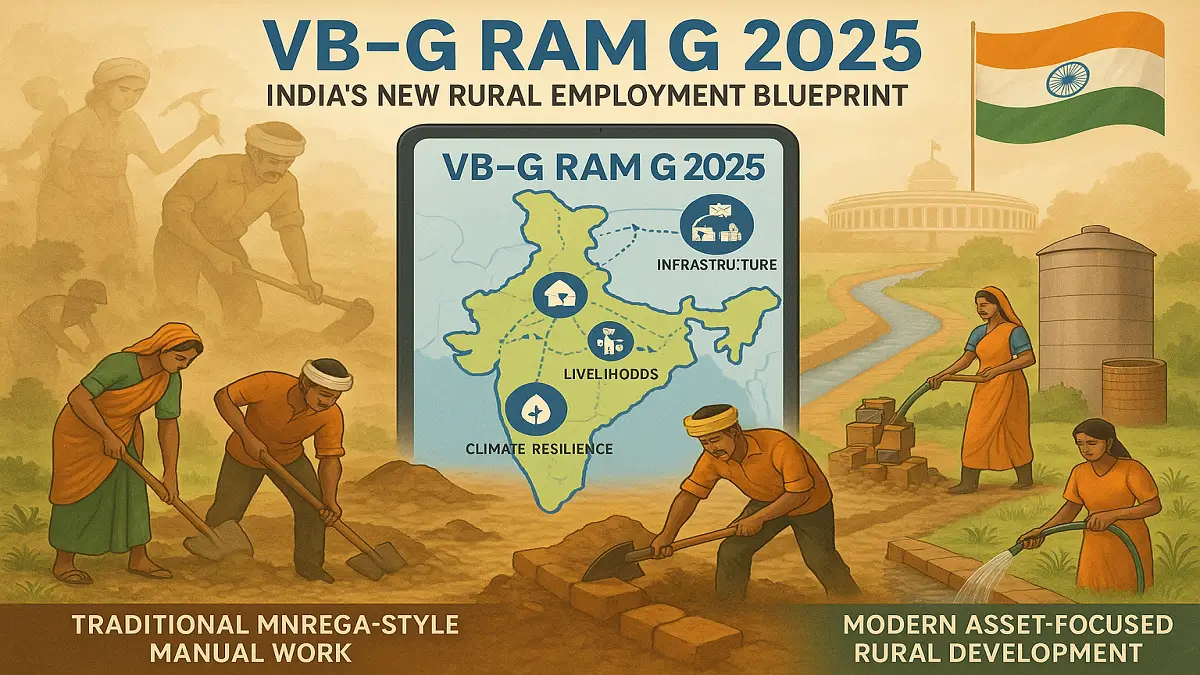
The Viksit Bharat–Guarantee for Rozgar And Ajeevika Mission (Gramin) Act, 2025 (VB-G-RAM-G) has officially repealed and replaced the 20-year-old MGNREGA (2005). While the government labels it an “evolution” aimed at Viksit Bharat 2047, it marks a fundamental shift from a demand-driven welfare right to a supply-driven infrastructure framework.
Under the mentorship of Dr. Ramanna Gowda, we have broken down the core differences that every aspirant must know for the upcoming KPSC and UPSC mains.
The concept of a “guaranteed right to work” in India didn’t start in 2005. Its ancestor was the Employment Guarantee Scheme (EGS) launched by the Maharashtra government following the severe drought of 1972-73. It became a legal guarantee in 1975 and served as the primary inspiration for a national-level law.
Before a statutory law was passed, several “schemes” were tested:
NREP (1980) & RLEGP (1983): Early central programs focused on wage employment and rural infrastructure.
Jawahar Rozgar Yojana (JRY – 1989): A major step that decentralized implementation to the Village Panchayats.
SGRY (2001): Integrated earlier schemes to focus on food security and infrastructure.
Passed on August 25, 2005, the Mahatma Gandhi National Rural Employment Guarantee Act (MGNREGA) was revolutionary because it was an Act, not just a scheme. It turned employment into a legal right for the first time in human history at such a scale.
Core Philosophy: Demand-driven (if you ask for work, the state must provide it).
Funding: 100% of unskilled wages borne by the Central Government.
While successful, MGNREGA faced structural hurdles over two decades:
Incomplete Assets: Many projects remained “on paper” without finishing.
Corruption: Wage theft and “ghost workers” led to the introduction of the Aadhaar-Based Payment System (ABPS).
Agricultural Conflict: Farmers complained that public works diverted labor during peak harvest seasons, leading to labor shortages.
Introduced in the Lok Sabha on December 16, 2025, and receiving Presidential assent on December 21, 2025, the Viksit Bharat–Guarantee for Rozgar And Ajeevika Mission (Gramin) officially repealed MGNREGA.
Why the name change? The new Act aligns with the Viksit Bharat @2047 vision. It shifts the focus from simple “poverty alleviation” to “strategic asset creation” (National Infrastructure Stack).
| Era | Key Legislation/Scheme | Nature of Program |
| 1972 | Maharashtra EGS | State-level Drought Relief |
| 1989 | Jawahar Rozgar Yojana | Decentralized Central Scheme |
| 2005 | MGNREGA | Rights-Based Legal Guarantee (100 Days) |
| 2025 | VB-G-RAM-G Act | Mission-Mode Infrastructure Focus (125 Days) |
Stay updated with the latest in Indian Governance and Economy. Our classroom programs and test series are meticulously updated to include these recent legislative changes.
Visit us: www.amoghavarshaiaskas.in
Expert Mentorship: Dr. Ramanna Gowda
Call for Admissions: +91 9916766911
Location: Bangalore, Karnataka.
Maximize the benefits of mock tests for IAS and KAS preparation with guidance from Amoghavarsha IAS Academy . For more details, visit https://amoghavarshaiaskas.in/.
Youtube: click here


Amoghavarsha IAS/KAS Academy was founded in 2014 since from their we have been excellence in the field of civil Service examination preparation and state services. The Academy is completely dedicated to provide excellent quality education by experts and bringing innovations etc.
Copyright © 2014 – 2024 Amoghavarsha IAS Academy. All Rights Reserved
Developed & Maintained by BIGGSITE– Manikanta G.V
Amoghavarsha E Magazine
Current Affairs ( Prelims )
UPSC
KPSC