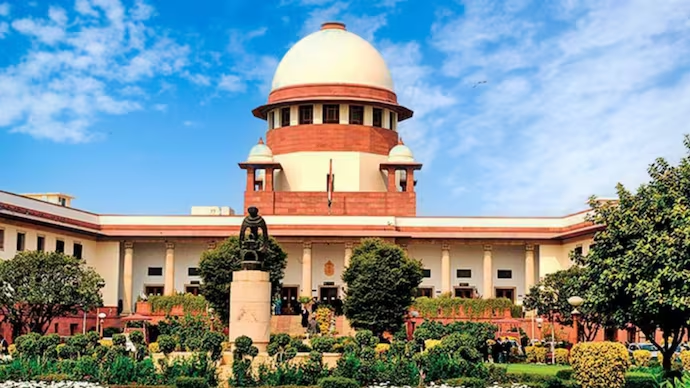
Free and fair elections are the cornerstone of Indian democracy. The accuracy of electoral rolls plays a critical role in ensuring electoral integrity. In this context, the Special Intensive Revision (SIR) of electoral rolls has repeatedly come under judicial scrutiny. The Supreme Court of India, while hearing petitions related to SIR, has laid down important constitutional and procedural principles that are highly relevant for UPSC Prelims and Mains.
Under the mentorship of Dr. Ramanna Gowda, we have broken down the core differences that every aspirant must know for the upcoming KPSC and UPSC mains.
Special Intensive Revision (SIR) is a comprehensive revision of electoral rolls conducted by the Election Commission of India (ECI) under the Representation of the People Act, 1950.
Unlike routine annual revisions, SIR involves:
Door-to-door verification
Fresh enumeration of eligible voters
Deletion of bogus, duplicate, or ineligible entries
Inclusion of genuine eligible voters
Purpose: To ensure purity, accuracy, and credibility of electoral rolls.
Article 324 of the Constitution – Superintendence, direction, and control of elections vested in ECI
Representation of the People Act, 1950
Registration of Electors Rules, 1960
The ECI has wide powers, but these powers are not absolute and remain subject to constitutional limitations.
Petitions challenging SIR generally raise concerns regarding:
Mass deletion of voters
Exclusion of migrant workers, urban poor, minorities
Lack of proper notice and hearing
Violation of Article 14 (Equality) and Article 21 (Right to Life & Dignity)
Indirect impact on Article 326 (Universal Adult Franchise)
The Supreme Court was approached to ensure that the revision process does not become arbitrary or exclusionary.
The Supreme Court has consistently held that:
Voting is a statutory right, not a fundamental right
However, arbitrary exclusion affects democratic participation
Removing bogus voters is essential
But genuine voters must not be disenfranchised
UPSC Quote Tip:
“Democracy thrives not merely on purity of rolls, but on inclusive participation.”
The Court stressed:
Proper notice before deletion
Opportunity to be heard
Transparent procedures
Grievance redress mechanisms
Article 324 gives wide powers
But actions must be reasonable, non-arbitrary, and proportionate
Article | Relevance |
|---|
| Article 324 | Powers of ECI |
| Article 326 | Universal adult suffrage |
| Article 14 | Equality before law |
| Article 21 | Right to dignity |
| Basic Structure | Democracy & free elections |
Risk of voter suppression
Administrative overreach
Digital divide affecting verification
Impact on internal migrants
GS Answer Tip: Mention social justice + federalism + democracy angles.
Use of technology with human oversight
Robust appeal mechanisms
Awareness campaigns before SIR
Independent audits of electoral rolls
Coordination between ECI and State machinery
The Supreme Court’s intervention in SIR cases reinforces the principle that electoral integrity and voter inclusion must go hand in hand. For UPSC aspirants, this issue beautifully connects constitutional values, democratic governance, and institutional accountability, making it a high-scoring topic for GS Paper II.
Stay updated with the latest in Indian Governance and Economy. Our classroom programs and test series are meticulously updated to include these recent legislative changes.
Visit us: www.amoghavarshaiaskas.in
Expert Mentorship: Dr. Ramanna Gowda
Call for Admissions: +91 9916766911
Location: Bangalore, Karnataka.
Maximize the benefits of mock tests for IAS and KAS preparation with guidance from Amoghavarsha IAS Academy . For more details, visit https://amoghavarshaiaskas.in/.
Youtube: click here


Amoghavarsha IAS/KAS Academy was founded in 2014 since from their we have been excellence in the field of civil Service examination preparation and state services. The Academy is completely dedicated to provide excellent quality education by experts and bringing innovations etc.
Copyright © 2014 – 2024 Amoghavarsha IAS Academy. All Rights Reserved
Developed & Maintained by BIGGSITE– Manikanta G.V
Amoghavarsha E Magazine
Current Affairs ( Prelims )
UPSC
KPSC