Operation Searchlight was a planned, ruthless military operation launched by the Pakistan Army on the night of March 25, 1971. Its primary objective was to crush the Bengali nationalist movement in East Pakistan (now Bangladesh) by arresting or eliminating political leaders, intellectuals, and student activists who were demanding autonomy and democratic rights.
Under the mentorship of Dr. Ramanna Gowda, we have broken down the core differences that every aspirant must know for the upcoming KPSC and UPSC mains.
The roots of the operation lay in the 1970 Pakistani General Elections.
The Mandate: The Awami League, led by Sheikh Mujibur Rahman, won 160 out of 162 seats in East Pakistan, securing an absolute majority in the National Assembly.
The Refusal: The ruling military junta in West Pakistan, led by General Yahya Khan, and political leaders like Zulfikar Ali Bhutto, refused to transfer power to a Bengali-led government.
The Deadlock: Following failed negotiations and a massive non-cooperation movement by Bengalis, the military decided on a “force-based solution” to maintain the unity of Pakistan.
Fiscal responsibility focuses on maintaining macroeconomic stability while supporting growth.
Prudent management of fiscal deficit
Rationalisation of government expenditure
Focus on quality of spending rather than mere expansion
Strengthening tax compliance and revenue mobilisation
Builds investor confidence
Ensures long-term debt sustainability
Prevents crowding out of private investment
This kartavya aligns with the Fiscal Responsibility and Budget Management (FRBM) framework.
Inclusive growth aims to ensure that economic progress benefits all sections of society, especially the vulnerable.
Support for MSMEs and startups
Employment generation and skill development
Targeted welfare for women, farmers, youth, and the poor
Strengthening social sector spending (health, education, nutrition)
Reduces inequality
Strengthens social cohesion
Enhances human capital formation
This kartavya reflects the constitutional vision of social and economic justice.
Sustainable development integrates economic growth with environmental protection.
Green energy and clean mobility
Climate-resilient infrastructure
Promotion of circular economy
Resource efficiency and reduced carbon footprint
Supports India’s climate commitments
Enhances long-term economic resilience
Protects ecological balance
This kartavya aligns with SDGs, climate action goals, and India’s environmental commitments.
The framework highlights:
Shift from entitlement-based governance to responsibility-based governance
Balance between growth, welfare, and sustainability
Outcome-oriented and citizen-centric budgeting
It reflects the idea that rights must be complemented by duties in public policy.
Budget concepts
Fiscal responsibility principles
Sustainable development basics
GS Paper III: Indian Economy, budgeting, inclusive growth, sustainability
GS Paper II: Governance and policy frameworks
Essay: Responsible governance and development
Budget as a governance tool
Balancing growth with fiscal discipline
India’s development priorities
Managing fiscal pressures amid global uncertainty
Ensuring last-mile delivery of welfare schemes
Balancing development needs with environmental concerns
Capacity constraints at state and local levels
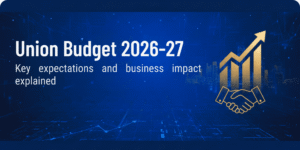
The Union Budget 2026–27, through the framework of the “Three Kartavyas”, presents a holistic vision of governance that combines fiscal prudence, inclusive growth, and sustainable development. For civil services aspirants, this theme provides a strong conceptual lens to analyse India’s economic and governance priorities.
Understanding such frameworks helps aspirants write balanced, multidimensional answers, a key requirement for success in competitive examinations.
Strengthen monitoring of budget outcomes
Improve Centre–State coordination
Promote transparency and accountability
Encourage citizen participation in governance
Stay updated with the latest in Indian Governance and Economy. Our classroom programs and test series are meticulously updated to include these recent legislative changes.
Visit us: www.amoghavarshaiaskas.in
Expert Mentorship: Dr. Ramanna Gowda
Call for Admissions: +91 9916766911
Location: Bangalore, Karnataka.
Maximize the benefits of mock tests for IAS and KAS preparation with guidance from Amoghavarsha IAS Academy . For more details, visit https://amoghavarshaiaskas.in/.
Youtube: click here


Amoghavarsha IAS/KAS Academy was founded in 2014 since from their we have been excellence in the field of civil Service examination preparation and state services. The Academy is completely dedicated to provide excellent quality education by experts and bringing innovations etc.
Copyright © 2014 – 2024 Amoghavarsha IAS Academy. All Rights Reserved
Developed & Maintained by BIGGSITE– Manikanta G.V
Amoghavarsha E Magazine
Current Affairs ( Prelims )
UPSC
KPSC